Spades - Classic Cards
- 4.8
- Rating
- 1.00M
- Installs
- Free
- Price

 Analysis by App-foxy
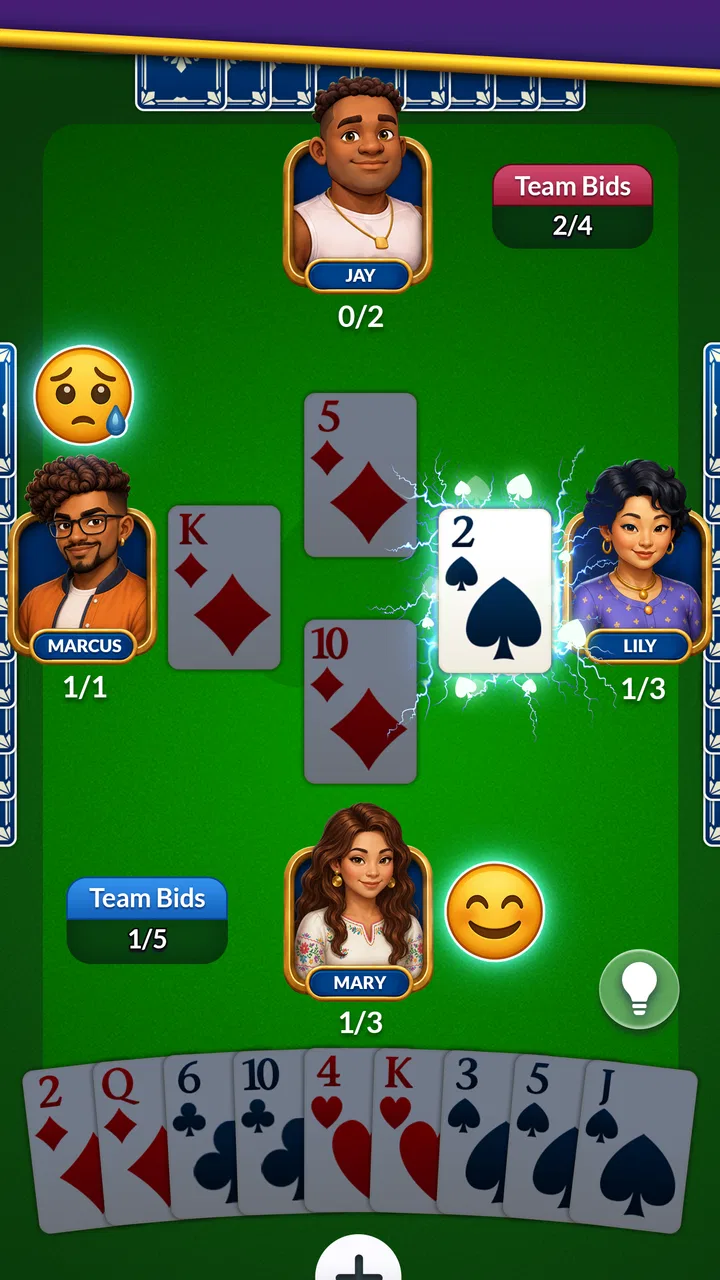
I enjoy card games most when they are easy to start but difficult to play well, and Spades - Classic Cards sits comfortably in that space. It is a free card game from Tripledot Studios Limited built around the familiar Spades format: choose a bid, follow suit when possible, decide when to spend a strong card, and try to finish the hand with the result you planned. The rules are recognizable, but the decisions arrive quickly enough to make a short break feel worthwhile.
My first impression is that this is less about spectacle and more about the small satisfaction of reading a hand correctly. You make a prediction, act on it, see whether the table agrees with your plan, collect the result, and then immediately face a new situation. That cycle is the real appeal. It gives the game a clear rhythm without demanding a long uninterrupted session.
The game belongs to the card category and is free to play. It is rated for Everyone, so it is a reasonable choice for families or for someone who wants a straightforward, nonviolent game rather than a complicated strategy title. It has passed the million-install mark and holds a 4.8 average from around 24 thousand ratings, which suggests that its simple presentation and familiar rules connect with a broad audience.
You May Also Like

 Blood Strike: 2.5 Anniversary
Blood Strike’s Loadouts Turn Every Drop Into a Tactical Gamble
A close look at Blood Strike’s custom loadouts: how fast access to signature weapons reshapes its battle royale rhythm, rewards preparation, and narrows the gap between fights.

 Pandora - Music & Podcasts
Pandora’s Music Is Easy to Start, but Harder to Recover
Pandora’s strength is its low-effort path from a seed to a station. Its weak spot is how much confidence it asks you to place in connection, setup, and quiet recovery.

 8 Ball Pool
 Is Built on Rivalries, Rematches, and Routine
A close look at the rivalries, rematches, shared routines, and unanswered safety questions that turn a quick pool match into a persistent mobile community.

 Samsung Music
’s Quiet Strength Is Playing What You Already Own
Its reach comes less from spectacle than from dependable access to a personal library. That simplicity is both the app’s strongest retention engine and its ceiling.

 AccuWeather: Weather Radar
AccuWeather Review: A Quick, Clear Forecast for Everyday Decisions
For everyday plans, the best forecast is the one you can understand quickly. AccuWeather makes rain timing, radar, and local conditions easy to act on, with a few trade-offs.

 Hill Climb Racing
Why Hill Climb Racing Still Turns Crashes Into One More Run
A tiny car, a bumpy hill and one more upgrade: Hill Climb Racing keeps resurfacing because its simple chaos makes every near-miss feel personal.
More From Our News Desk



How the Spades loop works in practice
I find it useful to treat each hand as a short cycle of planning, observation, and adjustment rather than judging a play in isolation. In this section, I focus on how the bid shapes the choices that follow, including one practical way to keep a promising hand from becoming a rushed one. That perspective also makes it easier to spot when a frustrating result comes from a decision I can change.
The first action is a prediction, not a guess
The most important decision comes before the first card is played. I look at the hand and estimate how many tricks I can realistically take. That estimate should account for high cards, the number of Spades available, and whether a suit looks short enough to create an opportunity later. A hand with several powerful cards may still be awkward if they are concentrated in the wrong suits, while a modest hand can become useful when it contains a carefully timed trump card.
This opening bid gives every hand a purpose. I am not simply trying to win as many tricks as possible. I am trying to win the number I announced, or at least stay close enough to avoid turning a promising round into a costly mistake. That distinction makes each play feel more deliberate than in many casual card games where the only obvious goal is to take the current trick.
New players should resist the temptation to bid based only on the highest card in the hand. A single strong card may win one trick, but it does not automatically support a larger prediction. I find it more useful to count reliable winners, then treat uncertain cards as possibilities rather than guarantees. This small change in thinking makes the game much less frustrating during the first few sessions.
The first card after the bid is another useful clue. If I lead a suit, I am revealing information about my own hand while watching how the other players respond. If an opponent cannot follow suit, that absence matters later because it may mean that player can use Spades when the suit returns. The game rewards attention to what is missing, not just what is visible.
Every trick creates a clear feedback rhythm
Spades has a satisfying action-and-feedback pattern. I choose a card, the table resolves the trick, and the outcome immediately tells me whether my earlier plan is holding together. A successful high-card play confirms part of the bid. A lost trick may reveal that I overestimated a suit. A carefully saved Spade can turn a doubtful hand into a manageable one, but using it too early can leave me without an answer when the table becomes dangerous.
That constant feedback keeps the game active even when the hand is not going perfectly. I am always updating my estimate. If my partner takes a trick I expected to win, I need to reconsider which cards remain available. If another player cuts a suit with Spades, I know that suit is no longer safe to lead casually. The best moments often come from adjusting rather than following the original plan rigidly.
One practical habit helped me improve: I mentally separate cards that are likely winners from cards that are merely attractive. An Ace may be dependable in one situation and exposed in another, especially if the suit has already been weakened by earlier plays. Likewise, a low Spade is not automatically valuable just because it is trump. Its usefulness depends on timing, the Spades already played, and whether I need to take a trick or avoid one.
The partner element also changes how I read the table. I cannot judge every trick only by my own cards. Sometimes the correct play is to let my partner win, even when I could take the trick, because preserving a strong card may be more important than collecting an extra one. This is where the game becomes more interesting than a basic high-card contest: the visible move and the sensible move are not always the same.
The reward is control over the next decision
The immediate reward is not merely winning a trick. It is gaining a clearer picture of the hand. Once several cards have been played, uncertainty shrinks. I know which suits are becoming dangerous, which opponents may be void in a suit, and whether my bid is still realistic. That information makes the next decision feel earned rather than random.
There is also a pleasant psychological payoff when a cautious bid works. Taking exactly the tricks I planned feels better than accidentally collecting a large pile of tricks, because the result reflects a chain of decisions. I had to judge the hand, protect key cards, and recognize when to spend them. The game makes that modest success repeatable, which is why one finished hand often leads naturally into another.
For someone using the game as a short break, this reward structure is especially effective. I can focus on one hand at a time rather than committing to a large campaign or learning a lengthy ruleset. A commuter, a person waiting for an appointment, or anyone who wants a quiet mental reset can get a complete decision-making experience without needing elaborate preparation.
At the same time, the reward is best suited to players who enjoy incremental improvement. This is not the right choice if I want constant visual excitement, a story, or a collection system to chase. The satisfaction comes from reading probabilities, remembering played cards, and making a better bid next time. Players who find traditional card logic repetitive may feel that the loop settles into a narrow pattern.
Why the reset makes another session tempting
When a hand ends, the reset is clean. The old mistakes no longer lock me into a bad position, and the next deal gives me a fresh set of problems. That matters because a poor result feels recoverable. I can look at what went wrong—an optimistic bid, a badly timed Spade, or a failure to account for my partner—and test a different approach immediately.
This reset also prevents the game from becoming emotionally heavy. A lost hand is disappointing, but it does not usually feel like a permanent setback. The next deal asks a new question, and the answer depends on a different combination of cards. I often continue not because I need to repair a long-term record, but because I want to see whether the next hand offers a better tactical puzzle.
There is a trade-off here. The quick reset can encourage “just one more” play, especially when the previous hand ended because of one avoidable error. That is enjoyable when I have time, but less helpful if I am trying to stop using my phone. The game’s compact structure makes it easy to fit into spare moments and equally easy to extend those moments longer than planned.
My most useful session routine is to pause briefly after a disappointing hand and identify one specific mistake before starting again. I might note that I counted an uncertain Queen as a guaranteed winner, or that I spent a Spade before learning who was void in a suit. This turns repetition into practice. Without that reflection, it is easy to blame the deal and repeat the same decision on the next hand.
Where it fits among other card games
Compared with Solitaire, this game gives me more interaction and more room to interpret other players’ choices. Solitaire is often better when I want a solitary puzzle with a calmer, more predictable flow. Spades feels more social in structure because the partner and opponents influence every decision, even when I am playing against computer-controlled competition.
Compared with fast-matching card games, it is slower and more thoughtful. There is no need to race through a pile or react to a constantly changing board. That makes it a better fit for someone who enjoys planning, but a weaker fit for anyone seeking rapid reflexes or flashy combinations. The core pleasure is strategic timing rather than speed.
It also differs from collectible card games, where building a deck and unlocking new options can be as important as playing individual matches. Here, the interest comes from working with the hand I receive. That keeps the entry barrier low and avoids the need to prepare a collection, but it also means there is less long-term variety outside the card decisions themselves.
The familiar rules are a strength for experienced Spades players, while newcomers may need a few hands to understand why a seemingly harmless card can create trouble later. I would recommend starting conservatively, watching which suits disappear, and treating the first several rounds as observation rather than a test of mastery. The game becomes more enjoyable once the table’s information starts to feel readable.
Practical details before installing
The game is currently listed as version 1.12.01 and supports devices running Android 7.1 or newer. That makes it accessible on many older Android phones, although the actual experience will still depend on the device’s screen, responsiveness, and general condition. I would keep the game updated when possible so that the installed version matches the current release offered by the developer.
Because it is free, it is easy to try without making a purchase decision first. That suits this kind of compact card game: I can install it, play several hands, and quickly decide whether the pacing matches my taste. The Everyone rating also makes it less restrictive as a casual family option, particularly for people who already know the rules of Spades and want a convenient digital version.
A prospective player should still consider the type of attention the game requires. It may look relaxing, but good play involves remembering suits, tracking the remaining Spades, judging the partner’s likely strength, and revising the bid as evidence appears. If I am tired and only want something completely passive, this can feel more demanding than expected. If I want a small mental challenge, that same demand is the reason it works.
The developer, Tripledot Studios Limited, has presented the game as a focused classic card experience rather than a broad entertainment package. I appreciate that focus, though it means the appeal depends heavily on whether I already enjoy the Spades rule set. The high average rating and roughly 2.8 thousand written reviews show strong reception, but popularity does not change the basic truth: this is a specialized card loop, not an all-purpose game for every mood.
Who should play it and who should skip it
I would recommend it to players who like games with short rounds, visible consequences, and decisions that improve through practice. It is particularly suitable for someone returning to Spades after years away, because the familiar structure makes it easy to reconnect with the rules. It also works for a player who wants a repeatable break-time game without a story, complex setup, or a long tutorial commitment.
It is less suitable for someone looking for a deep campaign, extensive customization, or a constantly changing set of mechanics. Players who dislike losing because of an awkward deal may also struggle with the format, even though careful play can reduce mistakes. Card games always include uncertainty, and no amount of planning turns every hand into a guaranteed win.
For a realistic everyday example, I could open it while waiting for a delayed appointment, play one hand, and stop after the reset if I only have a few minutes. If I have a longer break, I can continue while using each completed hand to review my bidding. That flexibility is one of its strongest qualities: the same basic game supports both a quick diversion and a more focused practice session.
My verdict on the complete loop
The loop is simple but well balanced: I assess the hand, make a bid, play cards, receive immediate evidence about my choices, collect the result, and begin again with a new puzzle. The action is small, the feedback is constant, the reward is improved control, and the reset makes failure easy to recover from. That structure explains why the game can be both relaxing and quietly demanding.
The strongest reason to try it is the quality of its repeated decisions, not the size of its feature list. When I want a familiar card game that rewards patience and observation, it gives me a dependable option at no cost. When I want spectacle, story, deck construction, or fast reactions, I would choose something else instead.
Overall, I think Spades - Classic Cards is a good recommendation for anyone who already enjoys Spades or wants a compact introduction to trick-taking strategy. It does not need to reinvent the format to be worthwhile. Its value comes from turning each deal into a manageable question, letting the result teach me something, and making the next hand feel like a genuine chance to play smarter.
FAQs for Spades - Classic Cards
01What features does Spades - Classic Cards offer?
Spades - Classic Cards offers a range of features to enhance your gameplay experience. These include customizable avatars, various difficulty levels, and both online and offline modes. You can also enjoy social features such as leaderboards and chat options, making it easy to connect with other players worldwide.
02Is Spades - Classic Cards free to play?
Yes, Spades - Classic Cards is free to download and play. However, it may offer in-app purchases for certain features or enhancements, such as removing ads or unlocking special themes and cards. These purchases are optional and not necessary to enjoy the core game.
03Can I play Spades - Classic Cards offline?
Absolutely! Spades - Classic Cards allows you to play offline against computer opponents. This is perfect for practice or when you don't have an internet connection. The AI difficulty can be adjusted to match your skill level, ensuring an engaging experience even offline.
04How can I track my progress in Spades - Classic Cards?
The app features an in-depth statistics section where you can track your wins, losses, and overall performance. This includes detailed breakdowns of your gameplay, helping you to understand your strengths and areas for improvement. You can also compare your stats with friends via social features.
05What should I do if I encounter technical issues with the game?
If you experience any technical issues, the first step is to ensure your app is updated to the latest version. If problems persist, you can contact the support team through the app’s help section or via their official website. They are typically responsive and will assist you in resolving any issues.
Pros
- User-friendly interface for easy navigation.
- Variety of game modes available.
- Smooth
- lag-free gameplay experience.
- Customizable card decks and backgrounds.
- Engaging multiplayer options.
Cons
- Ads can be intrusive at times.
- Limited offline play features.
- In-app purchases can be pricey.
- Occasional connectivity issues.
- Tutorials could be more detailed.

Spades - Classic Cards
Gallery